Africa Multiple Interactive Research Atlas (AMIRA)
Cluster Chronicles
Description
Description
enThe Africa Multiple Cluster Chronicles bring literary and artistic perspectives into the life of the Cluster: invited writers and artists spend a residency in Bayreuth, take part in its discussions and activities, and respond to them in essays, poems, photographs and other forms. A public engagement initiative of the Africa Multiple Cluster of Excellence, curated by Ute Fendler.
The 35th Swahili Colloquium, held at the University of Bayreuth from 19 to 21 May 2023, featured Jean Luc Raharimanana among three visiting artists. On the Saturday night he provided music and songs on a traditional Malagasy instrument accompanying a musical reading from Yvonne Adhiambo Owuor's novel Dragonfly Sea.
Kabaji offers a poem in which a Kenyan child speaks with a tree in Bayreuth about autumn, winter, spring and summer. The allegorical dialogue presents seasonal change as rest and renewal rather than death, and compares German trees with those in Kenya. The chronicle presents the poem as an example of the Narrative Transformation Model.
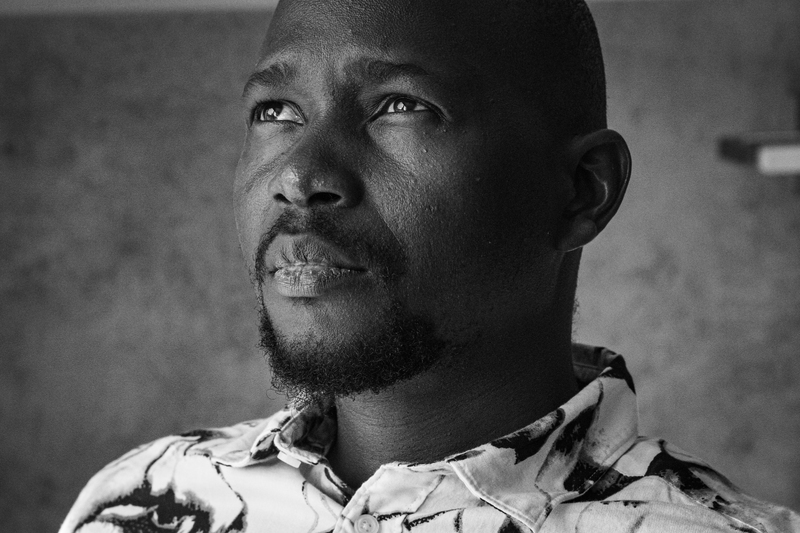
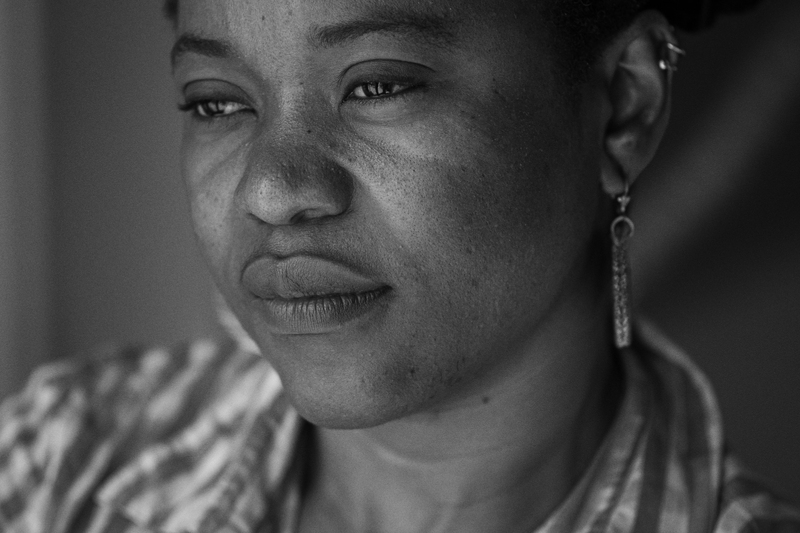
Black-and-white portrait of Maryam Shojaei from Umar Timol's series “Bayreuth en portraits”, made during his residency as Cluster Chronicler in May 2024.
Kabaji describes Wanda Gardens, a cultural space he founded in Kakamega in 2016 that houses the Kakamega Book Club and the Francis Imbuga Memorial Library. During a visit to the Richard Wagner Museum in Bayreuth he reflects on Wagner's theatre, on memory and museums, and on the moral complexity of historical figures. He concludes that cultural spaces at home need not imitate European institutions.
A French poem from Umar Timol's 2024 Cluster Chronicles series, printed with an English translation by Saffiyah Chady Edoo. It reflects on fleeting love, light and oblivion.
A first-person prose reflection written in Germany on feeling both familiar and estranged in a European public square. The text links the author's photographic framing of paved space, the silence of the street and his lack of the local language.
This long essay reflects on John's role as Cluster Chronicler, the vocabulary used by the Cluster's scholars, and clarity in academic writing. It draws on works by Eric Hayot, Harry G. Frankfurt and others, and includes hymn-style parodies of Cluster concepts. It also reports conversations with Cluster colleagues and describes an artist talk at the virtual conference.
This free-verse poem reflects on a recently ended conference, contrasting the vocabulary of definitions, modalities and reflexivity with the everyday details of conference life. It ends with a set of short observations about the Cluster's fellows, its theme and the town.
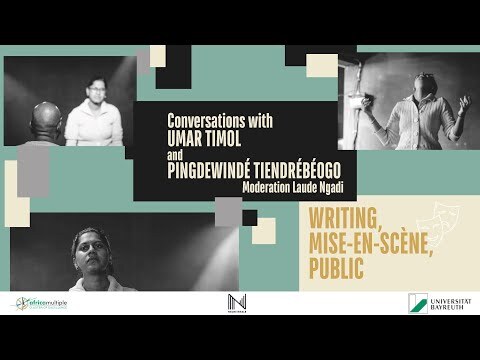
A discussion on theatre, writing and audience, scheduled for 23 May 2024 at Kulturhaus Neuneinhalb, Bayreuth, with Umar Timol and Dr. Pingdewindé Tiendrebeogo as discussants. The event page says it is held in English with free admission.
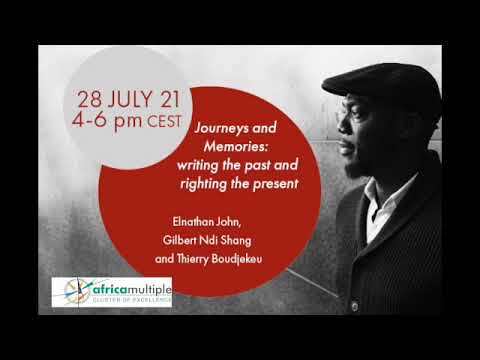
Elnathan John, the first Cluster Chronicler, in conversation with Gilbert Ndi Shang and Thierry Boudjekeu, published on the Africa Multiple Cluster of Excellence's YouTube channel at the start of his July 2021 residency.
A short lyrical text in French, with an English rendering on the same page, presented as an excerpt from the book La Voix, le Loin (Éditions Vents d’ailleurs, 2021). It meditates on believing again in the wings of the seasons that carry away impossibilities.
Kabaji reflects on the ninth day of his residency, when a message from a Kenyan colleague about motherhood reminded him of a vegetable seller's remark at Lurambi market. He links this to Brecht's The Good Person of Szechwan, to Kafka and to his experience of losing attention after leaving public office. The piece asks how worlds might value those who serve and sacrifice.
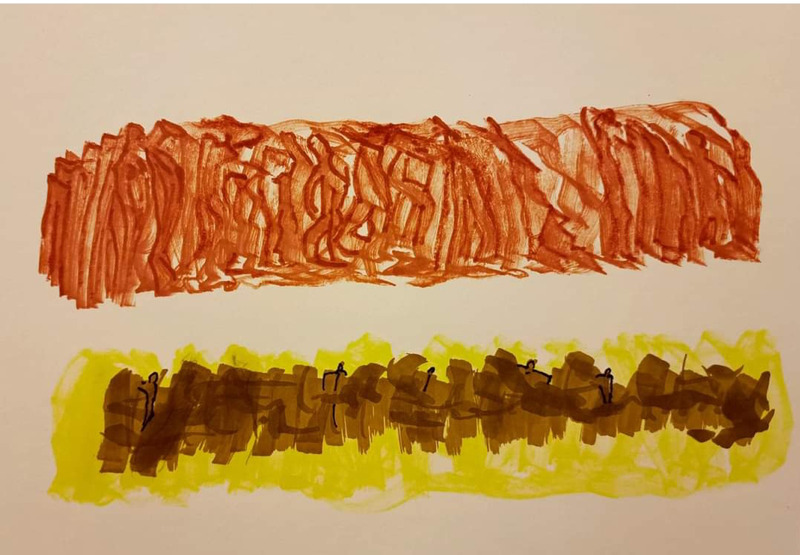
Drawing in two horizontal bands: a band of rust-orange strokes with standing figures, and below it dark brown strokes over yellow with small upright figures.
Photograph of the imprint of a hand in pale sand, lit warmly against a dark ground; one of the 16 photographs from Madagascar, Mayotte and the Comoros shown in the windows of Iwalewahaus.
Kabaji recounts meeting the Ugandan writer Stella Nyanzi at a gathering on African feminisms at Iwalewahaus in Bayreuth. He discusses her poetry, her imprisonment and exile, and her criticism of academic and African intellectual traditions. The chronicle asks why African scholars must travel to Europe to hold such debates.
A prose meditation that begins from the double meaning of the French word 'relief' (splendour and waste). It contrasts the orderly, clean city the author observes with bodily traces, youth gathering in a shopping centre and his detachment from news of his home country.
Kabaji considers how Bayreuth and Kenya remember writers, contrasting the preserved sites in Bayreuth, such as the Wagner museum and Iwalewahaus, with the lack of memorials for Kenyan writers. He reflects on literary tourism and on where authoritative knowledge about Africa is produced. The chronicle calls for earlier investment in writers' homes and legacies at home.
Kabaji sets out the Narrative Transformation Model in more detail, describing creative writing as a research-based process moving from curiosity through immersion, observation, investigation, reflection, imaginative transformation, narrative construction and validation. He relates these stages to the Cluster's concepts of multiplicity, relationality and reflexivity, using his novel Shadows of Love as an illustration. The text presents creative writing as a practice of world-making.
A public conversation with Umar Timol announced for 13 May 2024 at Kulturhaus Neuneinhalb, Bayreuth, organised by the Africa Multiple Cluster of Excellence. The announcement says he would talk about his work and his book Graces, a collection of black-and-white portraits.
A short French poem on the body and memory, printed with an English translation by Saffiyah Chady Edoo. It is about a body that is made of memory and blood.