

Publications
Origins & context
- Title
- Publications
Loading the visualisations…
Items
Clio-Guide : Afrika
Zur dritten Auflage: Was hat sich verändert? 2016 erschien die erste Auflage des Online-Handbuchs Clio-Guide. Ein Handbuch zu digitalen Ressourcen für die Geschichtswissenschaften; 2018 folgte die zweite um einige Guides zu wichtigen Themen ergänzte und soweit nötig auch bereits aktualisierte Auflage. Dass nun nur fünf Jahre später bereits die dritte Auflage erscheint, ist – neben der wahrnehmbaren Rezeption des Online-Handbuchs – auch der „Transformation of Historical Research in the Digital Age“ geschuldet.[1] „Over a generation of historical scholarship, the way in which historians research and write has dramatically changed. While many of these changes have been individually small, cumulatively they represent a transformation in the way that historical scholarship is researched, written, and published.“[2] Man kann zweifelsohne kontrovers über die Frage diskutieren, wie tiefgreifend in den letzten 20 bis 30 Jahren der Wandel geschichtswissenschaftlicher Praktiken tatsächlich war, dass die fortschreitende Digitalisierung einen Wandel in Gang gesetzt hat, dürfte unstrittig sein.[3] In den letzten fünf Jahren sind neue digitale Ressourcen für die Geschichtswissenschaft aufgelegt worden, dazu haben sich digitale Publikationsformen weiter etabliert und entwickelt. Beides liefert bereits gute Gründe für eine dritte Auflage der Clio-Guides und für einige konzeptionelle Veränderungen, die dafür vorgenommen wurden. Diese Veränderungen beziehen sich vor allem auf die Form der Online-Publikation, weniger auf die Kernidee. Was hat sich nun verändert, was ist neu gegenüber den ersten beiden Auflagen? 1. Anders als 2016 und 2018 wird das Online-Handbuch nicht mehr zu einem definierten Erscheinungstermin als Ganzes, als in sich abgeschlossene Veröffentlichung publiziert. Es bietet jetzt vielmehr einen Rahmen, in dem sukzessive Guides, nicht zuletzt auch zu neuen Themen, publiziert werden können. 2. Für ein Thema gibt es nun zwei Publikationsformen, den vertrauten Clio-Guide in Form eines „Artikels“, der nunmehr aber ergänzt wird um die Publikationsform einer „Liste“, die für den raschen Überblick eine Auswahl der wichtigsten Ressourcen mit kurzen Beschreibungen „auflistet“. Die Liste bietet – im Unterschied zum Artikel – die Option kurzfristiger Aktualisierungen, neue Ressourcen können in einem vorgegebenen Rhythmus aufgenommen, nötige Korrekturen bei nicht mehr gültigen URL’s vorgenommen werden. Zugleich erlaubt dies den Autorinnen und Autoren bei der Form des Artikels größere Freiräume bei Disposition und inhaltlicher Gestaltung. 3. Die Möglichkeiten des kontinuierlichen Ausbaus des Online-Handbuchs erlaubt in Zukunft auch stärker mit neuen Publikationsformen und –optionen zu experimentieren. Das können medial andere Formen wie Podcasts sein, aber auch neue Sparten, wie Diskussionen zu Fragen digitaler Methoden und der quellenkritischen Diskussion digitaler Ressourcen. Derartige Weiterentwicklungen sollen in den nächsten Jahren im Kontext des Teilprojektes Data Culture des NDFI4Memory-Projektes erfolgen. Zum Konzept der Clio-Guides Was sich nicht geändert hat, ist die Grundidee, das Konzept des Online-Handbuchs: Es soll weiterhin ein Werkzeug geschichtswissenschaftlicher Fachinformation sein, das in der Tradition der klassischen Bücherverzeichnisse und Bibliographien der Bibliographien steht, es geht weiterhin um das Handwerkszeug des Historikers. Das „Handwerk des Historikers“ ist in der Geschichtswissenschaft, stärker noch als in anderen geisteswissenschaftlichen Disziplinen, ein geflügeltes Wort. Es suggeriert ein solides, eben ein handwerkliches Fundament für das Fach. Und zweifelsohne ist die Geschichtswissenschaft in ihrer Methodik empirisch orientiert; sie gründet auf der Unterscheidung von „Fakten und Fiktionen“[5] als Basis für die darauf aufsetzenden Interpretationen und theoretischen Modellbildungen sowie die von manchen sogar als literarische Form verstandene Geschichtsschreibung. Dieser empirische Bezug der Geschichtswissenschaft fand auch in der Bildung der historischen Hilfs- oder Grundwissenschaften ihren Ausdruck, die das „Werkzeug des Historikers“[6] bilden und im Kern die Techniken zur kritischen Erschließung und Bewertung der Quellen als der empirischen Basis geschichtswissenschaftlichen Arbeitens bereitstellen. Zum Werkzeugkasten des Historikers gehören aber auch die Ressourcen und Instrumente seiner Fachinformation, um die es in der vorliegenden Publikation geht. Die Fähigkeit zu recherchieren, sich selbständig eine Übersicht zum Stand der Forschung zu einem bestimmten Thema zu erarbeiten, ebenso wie einschlägige Quellen dazu zu finden, gehört zu den grundlegenden Kompetenzen von Historikerinnen und Historikern – und mag zudem den Studierenden des Faches später auch in anderen beruflichen Kontexten als der wissenschaftlichen Geschichtsschreibung von Nutzen sein. So elementar die Kenntnis der Recherchewerkzeuge, der Suchmaschinen und Fachbibliographien, der Bibliothekskataloge und Archivrepertorien auch ist, so umfasst der Begriff und die Sache der Fachinformation doch noch mehr. Dazu gehört auch ein Verständnis der wissenschaftlichen Kommunikations- und Publikationsformen und ihrer Praktiken sowie der institutionellen Infrastrukturen, die diese ermöglichen. Früher konnte man sich diese Grundlagen der geschichtswissenschaftlichen Fachinformation über Bücherverzeichnisse oder sogenannte Bibliographien der Bibliographien erarbeiten.[7] Das geht heute schon lange nicht mehr. Gerade die Recherche, zunehmend die Nutzung von Quellen und peu à peu auch das Publizieren haben sich in den Raum digitaler Fachinformation verlagert.[8] Dazu kommt, dass die genannten herkömmlichen Publikationsformen der Fachinformation ergänzt wurden und werden um neue, genuin digitale und auch nur in digitaler Form realisierbare Produkte. Blogs, Podcasts, Kommunikationsnetzwerke, Fachnachschlagewerke als Wikis, sogenannte thematische Websites oder Thematic Research Archives[9], seien als Beispiele genannt. Ein Historiker muss mittlerweile die digitale Fachinformation seiner Disziplin kennen und in der Lage sein, sich ihrer Instrumente zu bedienen. Genau dazu will das vorliegende Online-Handbuch eine Einführung bieten. Darüber sollte freilich nicht vergessen werden, dass eine Historikerin, ein Historiker gleichsam zweisprachig sein muss. Sie müssen der digitalen Fachinformation kundig sein, denn es steht außer Frage, dass diese mittlerweile die primäre Basis für die Recherche ist und zunehmend auch die eigentlichen Publikationen zumindest in digitalen Parallelausgaben als digitale Zeitschrift oder als E-Book vorliegen. Zugleich aber bleiben Residuen zu deren Erschließung man noch gedruckte Bibliographien, Repertorien und Nachschlagewerke nutzen muss. Abgesehen davon steht es jedem, der die Beschäftigung mit der Vergangenheit zum Beruf macht, gut an, auch um die historischen Praktiken seines Faches zu wissen. Diese „Zweisprachigkeit des Historikers“ birgt immer noch ein gewisses Konfliktpotential, eine Spannung zwischen digitaler und gedruckter Fachinformation, zwischen bewussten Befürwortern und Propagandisten einer digitalen Geschichtswissenschaft und Anhängern der Gutenberg-Galaxis. Die Diskussion und Bewertung der digitalen Transformation geschichtswissenschaftlicher Fachinformation ist freilich ein Thema, mit dem sich diese Publikation bewusst und dezidiert nicht beschäftigt. Ob die klassischen Publikationsformen der Geisteswissenschaften, insbesondere die vielbeschworene große Monographie, als gedrucktes Buch weiterhin ihren Platz behaupten sollten, ist eine zu Recht gestellte und diskutierte Frage.[10] Eine Frage, mit der sich das Fach ebenso wie die Vertreter der verschiedenen Institutionen geschichtswissenschaftlicher Fachinformation, Verleger, Archivare und Bibliothekare, auseinandersetzen müssen - und vielleicht noch intensiver auseinandersetzen sollten als dies bislang geschehen ist. Ein weiteres grundsätzliches Thema, das bewusst (noch) nicht angeschnitten wird, wäre das weite Feld der „Digitalität an sich“, die Frage, inwieweit digitale Medien die bisherigen Publikationsgenres sprengen, zu neuen Epistemen und narrativen Formen führen und Methoden wie institutionelle Infrastrukturen verändern.[11] In dem vorliegenden Online-Handbuch geht es um etwas Einfacheres und Elementareres: Um die aktuelle Kartierung des Feldes der digitalen Fachinformation der Geschichtswissenschaft. Der Begriff der Fachinformation wird dabei bewusst breit verstanden, so dass auch institutionelle Infrastrukturen und digitale Werkzeuge mit darunter subsumiert werden. Unabhängig davon, wie man Fachinformation im Detail definiert, ist ihre Existenz ein Faktum, das professionelle Historikerinnen und Historiker zunächst einmal zur Kenntnis nehmen und das sie vor allem kennen müssen. Zur Erlangung dieser Kenntnisse will die vorliegende Online-Publikation Clio-Guide - Ein Handbuch zu digitalen Ressourcen für die Geschichtswissenschaften einen Beitrag leisten. Es verfolgt mithin primär ein praktisches Ziel: Eine bewusst positivistisch und faktenorientierte Einführung zum Stand der digitalen Fachinformation und eine Übersicht über die wichtigsten Hilfsmittel und Instrumente zu geben. Damit wendet es sich sowohl an Studierende und Lehrende, die sich die Grundlagen geschichtswissenschaftlicher Fachinformation erarbeiten bzw. diese vermitteln wollen, als auch an forschende Historikerinnen und Historiker, die eine Einführung in den Stand der Fachinformation in für sie neue Forschungsgebiete benötigen. Im Unterschied zu den neueren, vielleicht könnte man auch sagen, den letzten noch als Buch erschienenen Einführungen von Doina Oehlmann und Klaus Gantert oder dem englischsprachigen Pendant von Jenny L. Presnell[12], die einen primär propädeutischen Charakter haben und sich in den ersten beiden Fällen auf die Beschreibung weniger, aber zentraler, vornehmlich für die deutsche Geschichte und die deutsche Geschichtswissenschaft relevanter Ressourcen fokussieren, versucht die vorliegende Veröffentlichung in Ergänzung dazu einen thematisch wie konzeptionell weiteren Bogen zu schlagen. Konzeptionell weiter, weil zum Beispiel in den einzelnen Guides, je nach Thema, institutionelle Akteure und Konstellationen geschichtswissenschaftlicher Fachinformation neben der Auflistung und Beschreibung von Ressourcen vorgestellt werden; und thematisch wurde Wert darauf gelegt, dass nicht nur primär Ressourcen für die deutsche Geschichte, sondern für - so weit wie möglich - alle Regionen der Welt aufgenommen wurden. Gliederung des Handbuchs Zur Gliederung des Handbuches im Einzelnen (wobei nochmals darauf hingewiesen sei, dass in der Startausgabe der dritten Auflage noch nicht alle nachfolgend genannten Guides enthalten sind, sondern einige erst im Laufe der nächsten Monate publiziert werden): In einem ersten Teil wird unter der Überschrift Digitale Arbeitsformen und -techniken zunächst im Guide Digitale Geschichtswissenschaft: Methoden, Techniken auf konzeptionelle Fragen eingegangen. Digitale Technologien ermöglichenauch neue Methoden und Arbeitstechniken. Dazu kommt neu ein eigener Guide zu Institutionen digitaler Geschichtswissenschaft. Vielleicht am frühesten und zunächst am umfassendsten haben sich neue digitale Kommunikationsformen in der Geschichtswissenschaft etabliert, über deren Entwicklung und aktuellen Stand der Guide Kommunikation im digitalen Raum informiert. Neu hinzugekommen sind in der dritten Auflage die Guides Digitales Publizieren und Forschungsdaten. Wer sich mit digitalen Medien und Quellen beschäftigt, kommt nicht umhin, sich auch ein Grundlagenwissen zu technischen Aspekten zu erarbeiten. Eine Einführung zum technischen Verständnis digitaler bzw. digitalisierter Quellen bietet der Guide Digitale Quellen: Datei- und Datenformate und als neuer Guide zu methodischen Frage kommt Digitale Quellenkritik hinzu sowie ein Guide Digitalisierung des Kulturerbes des kolonialen Südens. Neben diesen Guides zu eher grundlegenden Aspekten werden auch konkrete Arbeitsinstrumente thematisiert: Digitale Werkzeuge sowie Fakten und Informationen im digitalen Raum - Von Lexika, historischen Sachwörterbüchern und biografischen Nachschlagewerken zu historischen Informationssystemen. Archive und Bibliotheken werden mitunter gerne als Labore der Historiker bezeichnet. Auch wenn bei der Verwendung dieser Metapher ein gewisses Spannungsverhältnis und ein Profilierungsstreben im Verhältnis zu den Naturwissenschaften unübersehbar ist, so hat sie durchaus ihre sachliche Berechtigung. Historikerinnen und Historiker brauchen Sammlungen, Institutionen und Orte, wo Quellen zusammengetragen, erschlossen und auf Dauer für die Nachwelt und die Angehörigen der geschichtsforschenden Zunft aufbewahrt werden. Ohne Wissen um diese Institutionen, ihre Funktionen, aber auch die Veränderungen, die diese durch die Digitalisierung ihrer Bestände erfahren, kann keine Forschung betrieben werden. Daher gibt es einen zweiten Teil zu Sammlungen, bei dem zunächst die Trias der klassischen Gedächtnisinstitutionen vorgestellt wird: Archive, Bibliotheken sowie Museen und Gedenkstätten - natürlich immer im Hinblick auf ihre „digitale Seite“. So wichtig in der Praxis Institutionen sind, im Mittelpunkt stehen natürlich die Materialien und Sammlungsgenres selbst. Neben einem Guide Historische Volltextdatenbanken wird daher auch noch auf eine Reihe wichtiger Quellengattungen eingegangen: Nachlässe und Autographen, Zeitungen, Bildquellen, Amtliche Publikationen, Statistische Daten sowie Karten. Im dritten und vierten Teil werden dann die klassischen Spezialisierungen des Faches behandelt: Epochen und Regionen. Im dritten Teil zu den Epochen führen Guides ein zur Alten Geschichte, dem Mittelalter, der Frühen Neuzeit, der Neueren Geschichte, dem „Langen 19. Jahrhundert“ und der Zeitgeschichte. Einen spezifischen Fokus haben die Guides Nationalsozialismus und Holocaust sowie DDR. Abgesehen von dem Guide zur Alten Geschichte haben die Epochen-Guides einen gewissen Schwerpunkt auf der deutschen Geschichte, auch wenn im einen oder anderen Fall der Blick auch darüber hinausgeht und, insbesondere im Guide zum langen 19. Jahrhundert weitere Regionen, insbesondere Westeuropas, miteinbezogen werden. Im vierten Teil zu den Regionen gibt es daher keinen eigenen Guide zu Deutschland. Auch wenn das Online-Handbuch mit Blick auf die Bedürfnisse der deutschen Geschichtswissenschaft geschrieben wurde, so kann und darf bei der zunehmenden Bedeutung globaler und transnationaler Geschichte für das Fach die Fachinformation nicht nur im Blick auf die deutsche Geschichte gesehen werden. Es wurde daher ein besonderes Augenmerk darauf gelegt, möglichst umfassend den Stand der digitalen Geschichtswissenschaft und ihrer Hilfsmittel zu europäischen und außereuropäischen Regionen durch jeweils eigene Guides abzudecken. Dies ist auch - mit Abstrichen - weitgehend gelungen. Es gibt Guides zu den Ländern Westeuropas, zu Frankreich, Großbritannien und Irland, den Beneluxstaaten Niederlande, Belgien, Luxemburg, zu Spanien, Italien, aber auch zu Österreich sowie der Schweiz und zu Nordeuropa; dazu kommen Guides zu Russland, Belarus, Ukraine, zu Polen, Tschechien, Slovakei und Südosteuropa. Afrika wird thematisiert, ebenso der Vordere Orient und Nordafrika sowie Südasien, Südostasien, China und Japan; weiterhin gibt es einen Guide zu Australien und Neuseeland sowie drei Guides, welche die Regionen des amerikanischen Kontinents abdecken: Kanada, USA und Lateinamerika. Natürlich sind nicht alle einzelnen Staaten der verschiedenen Kontinente abgedeckt. Es gibt Lücken - dazu gleich mehr. Im fünften Teil, der unter der Überschrift Themen firmiert, ist die Lücke nun freilich Prinzip. Der mittlerweile erreichte Spezialisierungsgrad der Geschichtswissenschaft würde hier eine Vielzahl von Guides zu unterschiedlichen Themen erlauben. Das Label Werkstattbereich soll deutlich machen, dass vor allem hier - ohne die anderen Teile des Handbuchs ausnehmen zu wollen - in Zukunft bei möglichen weiteren Auflagen der größte Raum für neue Guides ist. Bereits behandelt werden: Moderne Stadtgeschichte, Wirtschaftsgeschichte, Unternehmensgeschichte, Umweltgeschichte, Mediengeschichte, Europäische Religionsgeschichte der Neuzeit, Geschichte und Literatur sowie Jüdische Geschichte im deutschsprachigen Raum. Neu hinzu kommen in der dritten Auflage: Fachdidaktik, Technikgeschichte, Militärgeschichte, Public History, Wissensgeschichte, Rechtsgeschichte und Medizingeschichte. Desiderate, Überschneidungen, Aktualisierungen und Struktur der Clio-Guides Aufgrund der neuen Online-Publikationspraxis der dritten Auflage werden nicht gleich alle Guides zum ersten Online-Gang enthalten sein, aber weitere überarbeitete oder neue Guides werden sukzessive publiziert und über H-Soz-Kult angekündigt werden. Und es gibt natürlich auch Desiderate. Bei den regionalen Guides fehlen in Europa noch Portugal, Griechenland, Ungarn oder auch das Baltikum. Und natürlich könnte man die Großregionen Afrika und Asien durchaus noch weiter untergliedern oder Guides zum transpazifischen oder transatlantischen Raum und weiteren historischen Räumen erstellen. Im ersten Teil hätte man sich auch einen Guide zu den historischen Hilfswissenschaften vorstellen können. Für diese Desiderate gibt es unterschiedliche Gründe; manchmal ist das Fehlen eines Guides auch dem Stand der Forschung in der deutschen Geschichtswissenschaft zu der jeweiligen Region geschuldet. Wer die Publikation als Ganzes läse, würde bei den einzelnen Guides eine Reihe von Wiederholungen feststellen. Das liegt daran, dass bestimmte Ressourcen für mehrere Epochen oder Regionen von zentraler Bedeutung sind. Wer in Deutschland forscht und digitale Quellen und Fachzeitschriften nutzt, wird beispielsweise immer wieder auf von der Deutschen Forschungsgemeinschaft finanzierte Nationallizenzen stoßen; oder auf die EZB, die Elektronische Zeitschriftenbibliothek, ein Kooperationsprojekt deutscher wissenschaftlicher Bibliotheken, über die die Lizenzen und damit der Zugriff auf kommerzielle Zeitschriften administriert wird. Ebenso gibt es grundlegende Nachschlagewerke, wie die Deutsche Biographie, oder Kommunikationsnetzwerke, wie H-Soz-Kult, die für deutsche Historiker, gleich welcher epochalen, regionalen oder thematischen Spezialisierung sie sich verschrieben haben, genutzt werden und die daher immer wieder in unterschiedlichen Guides genannt werden. Weitere Beispiele ließen sich nennen. Diese Wiederholungen und Überschneidungen zwischen Guides wurden nicht nur in Kauf genommen, sie sind in dieser Form auch gewollt. Denn: Das vorliegende Online-Handbuch ist primär als ein Angebot für Einführungen gedacht, wobei die Gliederung des gesamten Werks sowie die Struktur der einzelnen Guides für die selektive, also die systematisch auswählende Lektüre konzipiert sind. Natürlich steht es jedem Leser frei, alle Beiträge - in ausgedruckter Form wären das weit über 1.000 Seiten - der Reihe nach zu lesen. Doch das dürfte nicht die primäre Form der Rezeption sein. Je nach seiner Fragestellung und Interessenslage dürften ein oder mehrere Guides ausgewählt werden. Je nachdem, ob jemand sich konkret mit einer Region, einer Epoche oder einem Thema beschäftigt, oder sich erst einmal für Hintergrundinformationen zur digitalen Transformation der Geschichtswissenschaft interessiert, können einzelne Guides gelesen werden. Bei der Gliederung der einzelnen Guides hatten und haben die Autorinnen und Autoren der dritten Auflage etwas mehr Freiraum als zuvor. Da die wichtigsten Ressourcen in die Publikationsform der Liste aufgeführt werden kann je nach Interesse von Autorinnen und Autoren im Artikel auch mehr auf Kontexte, Institutionen und Projekte eingegangen werden, die für das jeweilige Thema wichtig sind. In allen Guides wird – natürlich immer in Abhängigkeit vom jeweiligen Thema – möglichst immer eingegangen auf: Portale, Fachbibliographien, Bibliotheken, Archive, Museen sowie das Thema Kommunikationsdienste, Blogs und Social Media bis hin zu den eigentlichen digitalen Medien (Nachschlagewerke, Quellen, digitale Publikationen, thematische Websites, multimediale Publikationen). Auch wenn die vorliegende Publikation primär eine einführende und propädeutische Funktion hat, so hat sie, gleichsam nebenbei, noch einen weiteren Effekt: Sie dokumentiert bis zu einem gewissen Grad die digitale Formierungsphase zu einem definierten Zeitpunkt. Wenn sich Inhalt und Form der Publikation bewähren sollten und es zu regelmäßigen Aktualisierungen im Abstand von einigen Jahren käme, wäre diese Einführung in die digitale Fachinformation der Geschichtswissenschaft mithin in gewisser Weise auch eine wissenschaftshistorische Dokumentation des medientechnischen Wandels des Faches. Doch das ist, wie gesagt, keine primär beabsichtigte, aber durchaus einkalkulierte mögliche Wirkung. Mit der Frage des Wandels sei ein letztes Thema angesprochen: Die Frage möglicher Aktualisierungen und Erweiterungen. Die vorliegenden Guides versuchen, das Thema in methodischer, epochaler und regionaler Hinsicht möglichst umfassend abzudecken. Aber natürlich gibt es, wie bereits angesprochen, Lücken; Themen, die aus verschiedenen, zum Teil praktischen Gründen noch nicht berücksichtigt werden konnten. Es gibt daher die Option, das Online-Handbuch auszubauen und um weitere Guides zu ergänzen. Bei den bestehenden Guides können die Listen in kürzeren, wenn nötig auch jährlichen Fristen aktualisiert werden, die Artikel selbst in größeren Zeitabständen. Vor allem aber bleibt bei einer Online-Publikation die Option, neue Formate zu integrieren. Das wird eine Aufgabe der nächsten Jahre sein. Dank Ein Projekt wie dieses Online-Handbuch kann nur von einem Team von Autorinnen und Autoren geschrieben werden - im vorliegenden Fall sind es über 80. Das bedeutet auch, dass die Guides bei aller strukturellen Vereinheitlichung die unterschiedliche Handschrift der jeweiligen Autoren tragen. Deutlich wird bei der Lektüre, dass Historikerinnen und Historiker, die in Sammlungsinstitutionen arbeiten, mitunter durchaus andere Perspektiven haben als diejenigen, die primär in Forschung und Lehre aktiv sind. Diese Multiperspektivität, soweit man bei einer derart positivistisch orientierten Publikation wie der vorliegenden Einführung in die digitale Fachinformation der Geschichtswissenschaft davon sprechen kann, ist durchaus Teil des Konzeptes und soll im besten Fall der wechselseitigen Anregung dienen. Dass so viele Autorinnen und Autoren sich bereitgefunden haben, an einem solchen Publikationsprojekt mitzuarbeiten, ist alles andere als selbstverständlich, und das Herausgeberteam war und ist sich dessen bewusst und Allen zu großem Dank verpflichtet. Möge die vorliegende Publikationsform den Autorinnen und Autoren dafür eine möglichst gute und breite Rezeption durch Studierende wie Forschende verschaffen. Silvia Daniel, Wilfried Enderle, Rüdiger Hohls, Thomas Meyer, Claudia Prinz, Jens Prellwitz, Annette Schuhmann, Silke Schwandt Fußnoten⇑ [1] Milligan, Ian, The Transformation of Historical Research in the Digital Age, Cambridge 2022. [2] Ebda., S. 1. [3] Vgl. nur Donig, Simon; Rehbein, Malte, Für eine "gemeinsame digitale Zukunft". Eine kritische Verortung der Digital History, in: Geschichte in Wissenschaft und Unterricht 73 (2022), S. 527–545; Lässig, Simone, Digital History. Challenges and Opportunities for the Profession, in: Geschichte und Gesellschaft 47 (2021), S. 5–34; Crymble, Adam, Technology and the Historian. Transformation in the Digital Age, Urbana - Chicago - Springfield 2021; oder die in der von Andreas Fickers, Valérie Schafer, Sean Takats and Gerben Zaagsma beim Verlag DeGruyter herausgegebenen Reihe Studies in Digital History and Hermeneutics mittlerweile erschienenen Bände, zuletzt Digital History: Konzepte, Methoden und Kritiken Digitaler Geschichtswissenschaft, hrsg. von Karoline Döring, Stefan Haas, Mareike König und Jörg Wettlaufer (=Digital History and Hermeneutics, Bd. 6) Berlin – Boston 2022. [5] Evans, Richard J., Fakten und Fiktionen. Über die Grundlagen historischer Erkenntnis, Frankfurt/Main 1998. [6] Brandt, Ahasver von, Werkzeug des Historikers. Eine Einführung in die historischen Hilfswissenschaften, 18. Aufl., Stuttgart 2012. [7] Pars pro toto seien genannt: Baumgart, Winfried, Bücherverzeichnis zur deutschen Geschichte. Hilfsmittel, Handbücher, Quellen, 18. überarb. und erw. Aufl., Stuttgart 2014; Totok,, Wilhelm / Weitzel, Rolf: Handbuch der bibliographischen Nachschlagewerke, Bde. 1–2, 6. erw., völlig neu bearb. Aufl., Frankfurt/Main 1984–1985. [8] Vgl. Cohen, Daniel J.; Rosenzweig, Roy, Digital History. A Guide to Gathering, Preserving, and Presenting the Past on the Web, Philadelphia 2006; Schmale, Wolfgang, Digitale Geschichtswissenschaft, Wien - Köln - Weimar 2010; Haber, Peter, Digital Past. Geschichtswissenschaft im digitalen Zeitalter, München 2011; Milligan, The Transformation of Historical Research, 2022. [9] Vgl. Interchange: The Promise of Digital History, in: The Journal of American History, (95) 2008, S. 457: “Early digital history efforts were largely archival, often called “intentional archives” or “thematic research archives”.” [10] Vgl. Groebner, Valentin, Wissenschaftssprache digital. Die Zukunft von gestern, Konstanz 2014; Hagner, Michael, Zur Sache des Buches, Göttingen 2015; und als konsensorientierte wissenschaftspolitische Stellungnahme: Empfehlungen zur Zukunft des wissenschaftlichen Publikationssystems, Berlin-Brandenburgische Akademie der Wissenschaften, Berlin 2015. [11] Vgl. nur Schmale, Wolfgang, Digitale Vernunft, in: Historische Mitteilungen 26 (2013/2014) S. 94–100. [12] Oehlmann, Doina, Erfolgreich recherchieren - Geschichte, Berlin - Boston 2012; Gantert, Klaus, Elektronische Informationsressourcen für Historiker, Berlin - Boston 2011; Presnell, Jenny L., The Information-Literate Historian. A Guide to Research for History Students, 2. Aufl., New York 2013. Zitation: Clio-Guide: Einführung, in: Clio Guide – Ein Handbuch zu digitalen Ressourcen für die Geschichtswissenschaften, hrsg. von Silvia Daniel, Wilfried Enderle, Rüdiger Hohls, Thomas Meyer, Claudia Prinz, Jens Prellwitz, Annette Schuhmann, Silke Schwandt, 3. aktualisierte Aufl., Berlin 2023. Redaktion: clio.redaktion@geschichte.hu-berlin.de. Alle Rechte an Texten, Bildern und sonstigen Inhalten liegen bei Clio-online. (C) Clio-online 2002-2023.
Co-Creating Knowledge with Afro-Diasporic Communities : Reflections on a Participatory Research Process
Whereas ethnographic and interview-based approaches tend to monopolize the power of definition in the hands of the scientist, Participatory Action Research (PAR) aims at reconfiguring knowledge production towards a collective, mutually beneficial process. To overcome objectifying hierarchies between the researcher and the researched is particularly significant in ‘traumatic places’ such as Salvador (Brazil) and Cartagena (Colombia), two major ports of arrival during the trade in enslaved Africans. In this presentation, we share insights into the PAR process developed with Afro-diasporic communities from both cities before and throughout the pandemic. We reflect on the potentialities and limitations of the transdisciplinary co-production of knowledge(s), in which research ethics, topics, methods, concepts and outcomes are co-created by relating academia, arts and community work. Finally, we discuss to what extent a ‘detachment process’ from the investigated social field is possible in participatory research, on the one hand, to abstract and theorize from the situated lifeworld, and on the other hand, to mirror the interpretations of the involved actors in the academic theorizations.
Co-producing video performances across the Black Atlantic : an approach to participatory research-creation
Logocentric approaches to knowledge production can hardly address traumatic experiences such as the transatlantic trade in enslaved Africans. Video performances are a fruitful way to explore and exchange such embodied knowledges and collective memories, passing them on to future generations. This presentation gives insight into a participatory research-creation process developed with Afro-diasporic artists and community actors from Brazil, Colombia and Mozambique. We will show fragments of transdisciplinary video performances produced during the Covid-19 pandemic. They provide a means for personal and collective reflection and transcontinental collaboration at the intersection of artistic research and socially engaged art. This approach offers an important opportunity to connect diverse actors from both shores of “The Black Atlantic” (Gilroy, 1993). We will discuss the shifting roles between academic researchers and co-creators of knowledge from different socio-spatial contexts and artistic fields such as music, dance and poetry. Thereby, we will gauge the possibilities and limitations of transformation emerging from a co-creation of artistic/academic knowledges based on communal practices, joint reflections and mutual learning.
Commentary on "The Monkey's Profession" (مهنة القرد في الغابة) and "One Way" (ذهاب بلا عودة): Practical observations on form-knowledge in translation
My position in this chapter is a comfortable one for an academic: it is not my expertise, but my ignorance that is requested. I have been asked, as a “third party”, that is, as a non-native speaker of either language, to consider translations from Arabic into English.
Contestations over Agricultural Production in Colonial Africa
Agricultural history has enjoyed a rebirth in recent years, in part because the agricultural enterprise promotes economic and cultural connections in an era that has become ever more globally focused, but also because of agriculture's potential to lead to conflicts over precious resources. History is replete with stories of armies standing or falling as a result of their supply of agriculturally produced commodities. Civilizations have likewise succumbed because of famine or crop-related pestilence, highlighting the critical nature of agriculture to both regional and global society. The importance and fragility of agricultural systems will come into much greater focus because of climate change in the twenty-first century, something farmers the world over have begun to reckon with. As its implications are manifested in droughts and floods that hamper crop production, urban people will become ever more conscious of their own reliance upon agriculture. The contemporary critical evaluation of agriculture reflects a transition from a framework that celebrated the positive aspects of the evolution of agriculture to one that also explores its negative implications, such as the emergence of intensive and extractive agriculture that has worked to the detriment of indigenous peoples and disrupted traditional political economies. The Oxford Handbook of Agricultural History reflects this rebirth and examines the wide-reaching implications of agricultural issues, bringing together the many historiographical traditions within geographic regions across the world that intersect either directly or indirectly in terms of agricultural history. Contributors to this volume include historians from around the world and specialists in European, American, African, Middle East, Russian, and Asian history. Essays touch on the green revolution, the development of the Atlantic slave plantation, the agricultural impact of the American Civil War, the rise of scientific and corporate agriculture, and modern exploitation of agricultural labor. The Oxford Handbook of Agricultural History is an essential volume for those interested in the myriad ways that agricultural systems affect our world.
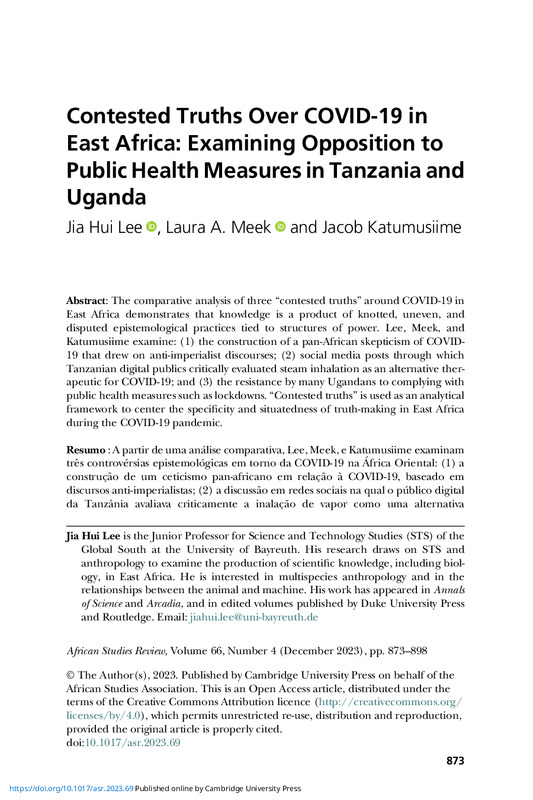
Contested Truths Over COVID-19 in East Africa : Examining Opposition to Public Health Measures in Tanzania and Uganda
The comparative analysis of three “contested truths” around COVID-19 in East Africa demonstrates that knowledge is a product of knotted, uneven, and disputed epistemological practices tied to structures of power. Lee, Meek, and Katumusiime examine: (1) the construction of a pan-African skepticism of COVID-19 that drew on anti-imperialist discourses; (2) social media posts through which Tanzanian digital publics critically evaluated steam inhalation as an alternative therapeutic for COVID-19; and (3) the resistance by many Ugandans to complying with public health measures such as lockdowns. “Contested truths” is used as an analytical framework to center the specificity and situatedness of truth-making in East Africa during the COVID-19 pandemic.
COVID-19 and (Im)mobilities in West Africa
This study examines recent developments of mobility patterns in West Africa within the context of the ongoing COVID-19 pandemic. A broad understanding of mobilities is applied to account for mobilities of people, goods and capital likewise. The aim is to track changes in mobility patterns caused by the pandemic and by institutional responses to the latter. The study may herein serve to encourage more in depth and comprehensive studies of the new (im)mobilities and the regimes that shape them. Embedding the subject of mobility changes into the political-economic framework of the networks of global capitalism and taking a perspective on the formative regimes, we develop first suppositions on how to apply the concept of (im)mobility regimes to assess the newly manifested (im)mobilisations. To shed light on the bigger picture of recent developments in Western Africa, this study tackles a wide range of mobility-related topics. At first, the epidemiological situation as well as the local testing regimes are analysed in order to assess the extent to which the pandemic is scientifically captured in Western Africa in contrast to other regions. By then providing a systematic outline of the lockdown policies of the individual ECOWAS member states, a first approach to the formative regimes can be given. The manifest new (im)mobilities of people are then evaluated with a focus on public transport, migratory movements and public air travel. Thereafter, the (im)mobilities of goods are discussed with a special focus on maritime freight mobilities. Finally, (im)mobilities of capital are dealt with in order to address changes and constants in the context of COVID-19, for example in the realm of remittances. Overall, this provides a first basis for a multi-dimensional understanding of the emerging phenomena in the ECOWAS region.
Decolonising education : An exploration in Bolivian-German relations
In this article I aim to contribute to a more multifaceted picture of what decolonising education can mean. I do this in the form of a case study of selected and intertwined Bolivian–German discourses and practices directed at the decolonisation of education in the wide sense of the term. First, I introduce Indigenist and ‘Indianist’ proposals, which are shaped, not least, by Nietzschean ideas. In a second step, I turn to some examples of German ‘Bildungsromane’ that are deeply entangled with Bolivian phenomena. Hence, the first part of the article is about decolonising the formerly colonised via education, whereas the second revolves around decolonising the former colonisers, but without the possibility for or the wish to identify completely clear-cut boundaries. It will thus become clearer how decolonising education can be understood as a relational phenomenon.
Descolonizando a Mente e o Olhar : “Xala” e a Impotência do Estado Pós-colonial
Entre as décadas de 1960 e 1970, na esteira das lutas anti-coloniais em África, vê-se surgir através do cinema a possibilidade de construção de uma identidade africana e uma autonomia cultural e política do continente. A linguagem cinematográfica configurou-se, naquele momento, numa ferramenta de discurso diante da dificuldade de escrita da História. A câmara, assim, tornou-se uma arma para a denúncia da impotência da classe política africana e, além disso, um meio para a reivindicação de uma imagem descolonizada do continente. Neste artigo, problematizo os conceitos de identidade, tradição e modernidade no contexto pós-independência africana, conforme a representação do filme Xala (1975) do cineasta-escritor senegalês Ousmane Sembène. Além disso, discuto os aspectos que possibilitaram a construção de um imaginário de superação da colonização e a articulação discursiva dessa tendência cinematográfica em torno da desejada revolução social em África.
Developing Crosslingual Ontologies in WissKI : Transcontinental Research Collaboration in the Africa Multiple Cluster of Excellence
Since July 2019, the Africa Multiple Cluster of Excellence at the University of Bayreuth has been funding a project dedicated to the creation of an Islamic Cultural Archive (ICA), a database designed for collaborative research in English, French and Arabic connecting researchers based in Germany and four African countries. The ICA project pursues individual but interconnected studies revolving around Islamic learning in Africa. Supported by IT specialists, we develop a digital platform that meets the related requirements. The ICA seeks to develop new approaches to the handling of data through establishing an ontology-based digital research environment building on WissKI, a set of modules that extends the content management system Drupal with semantic web technology. The chapter sheds light on the technical implications of our endeavor to connect diverse alphabets and data from various digital and digitized media. The research team members connect their diverse data sets to create synergies between various research foci and interests, ranging from the nexus of Islamic knowledge production, dissemination, and acquisition to the socio-religious, political-economic, and cultural dimensions of Islamic learning. The chapter shows how our system allows us to collect and archive different types of data, generate metadata through an ontology, and connect data beyond language barriers. Most notably, our data description method links the data through multilayered and multilingual tags, as well as through comprehensive cross-references, thus constituting an innovative way of data handling that can benefit researchers in Islamic Studies as well as cultural and literary studies more broadly.
Development in Sub-Saharan Africa New Micro-Level Evidence on Education, Geography and Trade
This dissertation contributes to the understanding of three pertinent developmental challenges in sub-Saharan Africa, namely education, geography, and trade. More specifically, it presents three independent and self-contained chapters which analyze these factors from a micro-level perspective, in turn. After a brief introduction in Chapter 1, Chapter 2 re-visits the role of physical geography in economic development. In particular, it employs a large-scale geo-referenced household-level survey covering 28 sub-Saharan African countries over 20 years to analyze the previously established link between coastal access and individual living standards. Analyzing individual-level data allows to expand on the insights from cross-country and cross-regional contexts and also facilitates the analysis of potential channels. The results show that individuals living further away from the coast are significantly poorer, as measured along a breadth of welfare indicators, such as basic consumption (water, food, medical care), possession of various consumer durables, or having paid employment. The chapter highlights the role of human capital, urbanization as well as infrastructural endowments in explaining the identified within-country differences in individual economic welfare. Chapter 3 investigates the effect of education on women's fertility and contributes to a growing literature which analyzes this nexus via quasi-experimental methods. Specifically, it leverages Burundi's Free Primary Education Policy of 2005 to identify exogenous variation in schooling via a Regression Discontinuity Design (RDD) and analyzes the outcomes affected by schooling through an instrumental variable (IV) approach. The results confirm the negative relationship between schooling and fertility observed in other developing settings. However, contrary to extant studies, the chapter provides novel evidence on a differential treatment effect of education. While poor women profit from policy-induced education in terms of increases in literacy, remunerated employment opportunities as well as a reduction in teenage births, none of these effects of additional education are observed for women from the wealthier households of our sample. The evidence of such a marked heterogeneity helps to evaluate under which conditions the literature’s previous findings may generalize. Chapter 4 evaluates the distributional effects of trade liberalization in Africa by combining the spatial considerations of regional market integration with a household-level analysis. The chapter thereby treats the re-establishment of the East African Community (EAC) in 2001 as a regional policy intervention having differential effects on individual households governed by their geo-spatial location within the countries. This prediction is derived from an extension to a canonical New Economic Geography (NEG) developed in the chapter. Contrary to the model’s prediction, the empirical results drawn from a difference-in-differences (DiD) approach do not reveal relative welfare increases in regions closer to internal EAC borders. Rather, the results provide evidence of strengthened agglomeration tendencies in the pre-existing economic hubs of Nairobi, Dar es Salaam and Kampala, as measured by an increase in consumption and population density.
Die Selbstverständlichkeiten von Schule und Kinderarbeit
Wie selbstverständlich es in Deutschland geworden ist, dass alle Kinder eine Schule besuchen, zeigen die Schul- und Kitaschließungen während der Corona-Pandemie. Dass Kinder den ganzen Tag zu Hause sind, ist eine ungewohnte Situation für viele Haushalte und beeinträchtigt den Arbeitsalltag ihrer Eltern. Im Gegensatz dazu ist es in anderen gesellschaftlichen Kontexten selbstverständlich, dass Kinder die Arbeit ihrer Eltern begleiten und selbst mitarbeiten. Die Durchsetzung einer allgemeinen Schulpflicht und ein Verbot von Kinderarbeit stellt diese Haushalte vor Herausforderungen.
Disputed Meanings of Women’s Liberation : Social Tensions and Symbolic Struggles During Angolan Independence
During the armed struggle, the Popular Movement for the Liberation of Angola (MPLA) supported women's liberation and appointed women to several political, logistical, and military positions. Meanwhile, in colonial society, changes in economic activities, access to formal education, and urban sociability resulted in a more significant female presence in public spaces. After independence, women's liberation rose to prominence in a context of internal conflict and economic disruption. The new government promoted the “New Man” and a host of associated social personae, all of which were defined by a set of moral qualities individuals were expected to comply with if they wanted to qualify as legitimate actors in the making of independent Angola. Women ought to engage in “National Reconstruction” by joining the Organization of Angolan Women (OMA), which focused on literacy and hygienist campaigns aimed at fighting “obscurantism”. However, many urban women had their own agendas, which called for changes in gender roles in both public and domestic realms. This paper seeks to highlight the shifting gender patterns in Luanda and rural guerrilla zones during the late colonial period, and then analyze how, after independence, different groups of women conceived their place in the building of the new nation, and how the State tried to “domesticate” the possibilities of women's activism as such, in symbolic as well as practical ways.
DjumbaiALA : Contributing to Polyphonic Dialogues across the Middle Passage
Founded five years ago, DjumbaiALA is a network committed to enhancing intercultural conversations and a non-hierarchical co-production of knowledge in the Global South. Diverse researchers, artists and activists from Latin America, Africa and Europe are contributing to this cause.
DjumbaiALA : Dialoge afrikanischer und afro-diasporischer Wissensformen im multimedialen Zeitalter
Eine funktionierende Wissenschaftskommunikation außerhalb des akademischen Feldes stellt gerade bei Kooperationen mit benachteiligten Bevölkerungsgruppen im Globalen Süden eine herausfordernde Notwendigkeit dar. Dahingehend bedarf es nicht nur ausreichender Open-Access-Zugangsmöglichkeiten, sondern ebenso sach- und zielgruppengerechter Übersetzungen, welche sowohl sprachliche, als auch soziokulturelle und wissensbasierte Deutungsbarrieren überwinden. Das Projekt "DjumbaiALA: Dialoge afrikanischer und afro-diasporischer Wissensformen im multimedialen Zeitalter" ermöglicht die Durchführung eines Workshops in Salvador da Bahia (Brasilien), der Nachwuchswissenschaftler*innen und Expert*innen aus den Bereichen digitales Design, Performance und Afrikastudien vereint. Als deutsch-brasilianisches Kooperationsprojekt zielt das Vorhaben darauf ab, das erste multimediale E-Book des transdisziplinären Netzwerks DjumbaiALA zu produzieren, um innovative Wege in der digitalen Wissenschaftskommunikation einzuschlagen. Durch die kollaborative Erschaffung dieses Prototyps werden institutionelle Partnerschaften gefestigt, auf deren Grundlage künftig weitere multimediale E-Books erstellt werden sollen. Indem Textelemente auf kreative Weise mit audiovisuellen Inhalten verknüpft und in unterschiedlichen Sprachen bereitgestellt werden, erhöht sich die Sichtbarkeit und Reichweite von sozial- und geisteswissenschaftlichen Forschungsergebnissen. Die Originalität des Projektes besteht insbesondere darin, dass mittels der multimedialen DjumbaiALA Books ein Wissensaustausch auf Augenhöhe zwischen dem Globalen Norden und Süden angestrebt wird. So können nachhaltige Lösungen für globale Herausforderungen erarbeitet werden.
Doing ethics : An outline of a constructivist and phenomenological approach of moral communication
Situated at the crossroads of pragmatics and interactional linguistics, the aim of the present working paper is to sketch a theoretical framework that is able to capture the linguistic and communicative facets of everyday moralities. Based on a phenomenological, constructivist and dynamic understanding which is informed by recent sociological and anthropological research, the case is made that moralities are best conceptualized as an interactional achievement, in other words, as ‘doing ethics’. Moreover, it is argued that communication plays a major role in doing ethics. Hence, moralities are explored in relation with language. The focus is on everyday moral communication and, in particular, on the verbal means and communicative practices conventionally used to signal moral meanings. The main purpose is to flesh out a conceptualization of doing ethics which opens up this domain for pragmatic and interactional approaches. Thus, theoretical considerations are prevalent in the working paper.
Doing ethics. An outline of a constructivist and phenomenological approach of moral communication
Situated at the crossroads of pragmatics and interactional linguistics, the aim of the present working paper is to sketch a theoretical framework that is able to capture the linguistic and communicative facets of everyday moralities. Based on a phenomenological, constructivist and dynamic understanding which is informed by recent sociological and anthropological research, the case is made that moralities are best conceptualized as an interactional achievement, in other words, as ‘doing ethics’. Moreover, it is argued that communication plays a major role in doing ethics. Hence, moralities are explored in relation with language. The focus is on everyday moral communication and, in particular, on the verbal means and communicative practices conventionally used to signal moral meanings. The main purpose is to flesh out a conceptualization of doing ethics which opens up this domain for pragmatic and interactional approaches. Thus, theoretical considerations are prevalent in the working paper.