

Publications
Origins & context
- Title
- Publications
Loading the visualisations…
Items
Limitations and Opportunities of Child Participation in Climate Change Litigation in Africa.
Climate change legal frameworks call upon countries to mitigate and adapt to the adverse effects of climate change. These frameworks have influenced the creation of policies and laws addressing climate change across the globe. Activists, individuals, and civil society organisations have utilised campaigns, demonstrations, and climate change litigation to compel countries to adhere to their climate change obligations provided in these frameworks. However, climate change litigation is still in its infancy and progressing slowly in African countries. Additionally, children’s involvement in such litigation is limited despite international and domestic legal frameworks permitting their participation. This article argues that children’s participation in climate change litigation in African countries is currently tokenistic and does not afford them meaningful involvement in the decision-making processes in climate change matters. Having presented the importance of child participation, it examines the opportunities and limitations of children’s participation in climate change litigation.
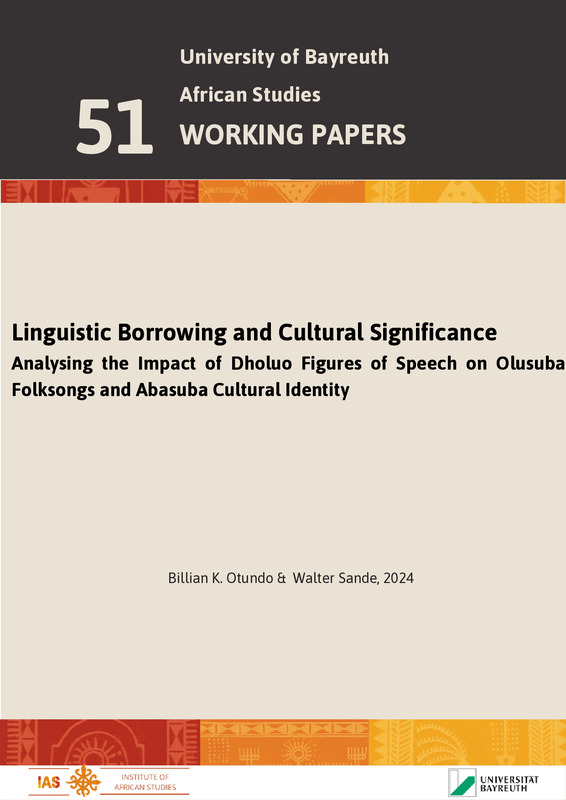
Linguistic Borrowing and Cultural Significance : Analysing the Impact of Dholuo Figures of Speech on Olusuba Folksongs and Abasuba Cultural Identity
This article discusses the dynamic interplay between language contact, cultural exchange, and expressive forms of communication within the multicultural societies of Abasuba and Luo living in Kenya. From a socio-pragmatic perspective of signification of figures of speech in Olusuba traditional folksongs, we elaborate on a social context that manifests and inducts the socio-pragmatics of linguistic borrowing, particularly figures of speech (FOS), from Dholuo into Olusuba traditional folksongs. Unique to this study is that in the Olusuba speech communities, speakers are found to communicate non-literally to convey ideas and/or knowledge borrowed from the Luo community. The analysis was grounded in the Semiotic Theory (Barthes 1983) and constructed around de Saussure’s Theory of Meaning (1916) which proposes that language is a union of signs whose relation between their physical and symbolic distinction is arbitrary and thus attains its meaningfulness through the rules of convention. An ethnographic research design was adopted and a qualitative analysis of linguistic features and thematic content in Olusuba folksongs was employed to examine how borrowed FOS contribute to the expressive power and cultural significance of these songs, particularly in conveying themes related to nature and socio-economic activities shared by the Abasuba and Luo communities. Additionally, the study investigates the broader implications of integrating borrowed FOS into Olusuba folksongs on the preservation and evolution of cultural identity among the Abasuba people. In this endeavour, intact cultural groups of Abasuba people in natural settings were interviewed on Dholuo-oriented Olusuba folksongs alongside non-participatory observation during the performance of the folksongs. The results, for example, revealed the use of linguistic symbols whose semantics have been induced by Olusuba-Dholuo contact. This research sheds light on the intricate relationship between language contact, cultural exchange, and identity formation in multicultural societies, offering insights into the complexities of linguistic and cultural dynamics in diverse communities.
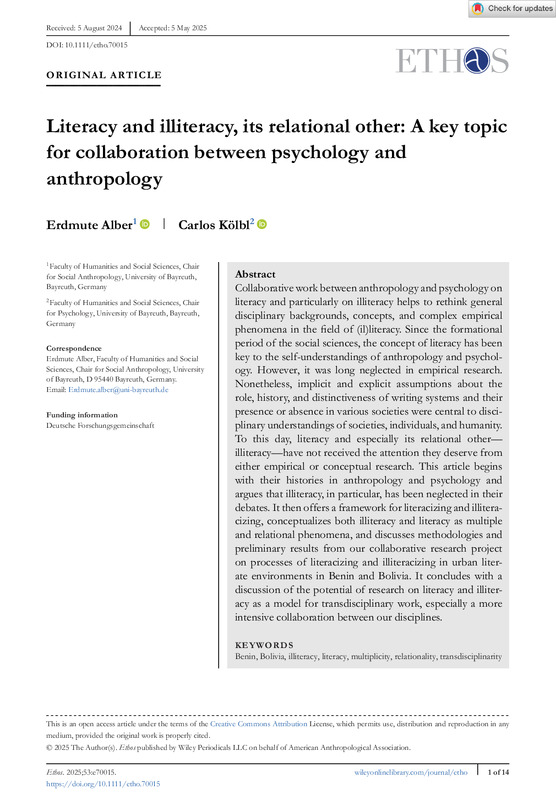
Literacy and illiteracy, its relational other : A key topic for collaboration between psychology and anthropology
Collaborative work between anthropology and psychology on literacy and particularly on illiteracy helps to rethink general disciplinary backgrounds, concepts, and complex empirical phenomena in the field of (il)literacy. Since the formational period of the social sciences, the concept of literacy has been key to the self-understandings of anthropology and psychology. However, it was long neglected in empirical research. Nonetheless, implicit and explicit assumptions about the role, history, and distinctiveness of writing systems and their presence or absence in various societies were central to disciplinary understandings of societies, individuals, and humanity. To this day, literacy and especially its relational other—illiteracy—have not received the attention they deserve from either empirical or conceptual research. This article begins with their histories in anthropology and psychology and argues that illiteracy, in particular, has been neglected in their debates. It then offers a framework for literacizing and illiteracizing, conceptualizes both illiteracy and literacy as multiple and relational phenomena, and discusses methodologies and preliminary results from our collaborative research project on processes of literacizing and illiteracizing in urban literate environments in Benin and Bolivia. It concludes with a discussion of the potential of research on literacy and illiteracy as a model for transdisciplinary work, especially a more intensive collaboration between our disciplines.
Live as African : On the Relevance of Thomas Sankara’s Agenda for Economic Liberation
"We must accept to live as African – that is the only way to live free and dignified", said the late Thomas Sankara in his famous 1987 speech at the Organization of African Unity. "Live as African", beyond summarizing Sankara's political and ethical vision, draws an agenda for economic liberation articulated around the ideal of self-sufficiency understood both as freedom from external domination and as capacity to self-determination through reliance first and foremost on one’s own resources. In this article, I argue that this agenda is the only one sustainable both for African peoples and for the Planet once it is realized that peoples from the periphery as a whole will never be able to achieve the same consumption/waste levels as peoples in the center, as global South thinkers Celso Furtado and Samir Amin demonstrated some decades ago. Since then, a growing literature has shown why the Western development “model”, due to its ecological exceptionalism, is simply not reproducible elsewhere and why the promise of economic catch-up is illusory. Building on these findings and on the importance and implications of monetary sovereignty, I will elaborate on the principles of a Sankara-inspired economic model that could deliver a free and dignified life to all.
Livelihood Transitions and Determinants in Rural South Africa: Insights from a Longitudinal Analysis of Households in Bushbuckridge, Mpumalanga Province
Rural South Africa is undergoing significant livelihood transformations, especially in areas vulnerable to socio-economic and environmental change. Using a longitudinal household panel dataset from Bushbuckridge, Mpumalanga Province, South Africa (2010–2021), this study examines livelihood dynamics, transitions, and their determinants through Hierarchical Cluster Analysis and multinomial logit regression. Three livelihood strategies were identified: (1) agrarian- local employment mix, (2) social grant-based, and (3) migrant employment-based. By 2021, around 50% of households had shifted strategies, mostly from agrarian-based to either social grant or migrant employment strategies. Reliance on social grants was higher among larger households and those with more elderly members, while households with more working-age adults favored migrant employment. These patterns reflect a decline in land-based livelihoods and a growing dependence on external income sources, reshaping rurality. The study highlights the need for place-based policies that promote local employment opportunities, support rural populations, and integrate social protection into rural development.
Local Languages, Global Futures : Language, Learning, and Sustainability in Africa
This volume explores the central role of African languages in shaping inclusive and sustainable futures across the continent. While Africa has long been viewed primarily as a source of extractable resources, its future strength lies in its people. With higher education access below 10% in Sub-Saharan Africa—compared to nearly 80% in the Global North—there is both an urgent need and a major opportunity to expand learning. Such expansion will only succeed if students can study in languages they know; using African languages as mediums of instruction is essential to unlocking the continent’s human potential. Drawing on perspectives from education, technology, public communication, and indigenous knowledge, the contributions show how local languages function as cultural anchors and as drivers of learning, innovation, and social transformation. They address issues such as scientific communication in African languages, terminology development, multilingual education policies, digitization and digital divides, language visibility in public life, education for hunter-gatherer communities, and media and the arts, illustrated through cases from across the continent. A concluding theoretical chapter examines broader challenges and opportunities for multilingual education in Africa. Together, the chapters demonstrate that strengthening African linguistic resources is vital for decolonizing knowledge production, empowering communities, and reimagining education systems that reflect Africa’s diverse realities and aspirations. With contributions from Doris Löhr, Comfort Beyang Oben Ojongnkpot, Taiwo Oloruntoba-Oju, Bert van Pinxteren, Ayodele Yusuff, Feyi Ademola-Adeoye, Adédoyinsolá Omowùnmí Eleshin, Emilisco Jones Enoachuo, Sarita Monjane Henriksen, Tomoe Noguchi, Omusula W. Omuholo
Luttes honnêtes : transformation structurelle, finances publiques et récurrence de la crise de la dette au Sénégal
Face à un monde plus multipolaire, les spécialistes de l’économie politique internationale affûtent leurs outils pour expliquer la longue durée des institutions postcoloniales, la subordination financière internationale et la quête d’autodétermination. Dans le cadre de ces débats, cet article développe le concept de « luttes honnêtes » au sein de l’histoire postcoloniale du Sénégal et se concentre sur trois d’entre elles. En premier lieu, les tentatives de faire évoluer l’économie sénégalaise en abandonnant les cultures de rente coloniales et l’influence française, de 1960 à 1980 ; ensuite, les efforts pour faire face à la crise de la dette des pays du Sud et à la dévaluation du franc CFA de 50 %, entre 1980 et 2004 ; enfin, la lutte visant à développer l’économie sénégalaise au sein d’un tout nouvel espace fiscal et de nouvelles formes de dette externe depuis le début de l’allégement international de la dette, de 2004 jusqu’à aujourd’hui. Je m’appuie sur des données financières, ainsi que sur des interviews réalisées à Dakar et à Paris, pour affirmer que ces luttes ont débouché sur une certaine transformation structurelle. Cependant, le danger de la crise de la dette n’a pas disparu et l’autodétermination économique demeure précaire. La dépendance continue aux capitaux étrangers a atteint des niveaux records ces dernières années. La subordination financière internationale est une condition structurelle de l’action gouvernementale des pays du Sud, qui ne cesse de menacer les progrès durement gagnés en matière d’autodétermination.
Mafone : dance theatre for knowledge co-creation
Theatre, music, dance and poetry performances provide means and methods to co-create knowledges in a way that brings emotional and bodily experiences into dialogue with academic reflections. Working through the trauma of enslavement, colonisation and their aftermath requires such highly sensitive methodologies to avoid further objectification and alienation of the people involved. In this colloquium, we launch a 45-min live recording of the dance theatre “Mafone – Oríkì da viagem” (“Mafone – Oríkì of the voyage”) directed by Brazilian transdisciplinary artist Diego Araúja, Colombian choreographer Jaime Gómez and Mozambican musician Matchume Zango. It is a major outcome of our approach to Orlando Fals Borda’s Participatory Action Research, which inspired us to organise an exchange programme between Afro-descendant artists and community actors from Salvador da Bahia (Brazil) and Cartagena de Indias (Colombia). We take this public video screening as an opportunity to reflect on our shifting roles as researchers, mediators and mentors of this process throughout the past three years, and open up a discussion on the potentials and limitations of combining arts and research. In particular, we consider the opacity through which both trauma and dreams can be reinvented in a non-harmful, but polysemantic way. Hence, we will take the public on a creative journey of transdisciplinary experimentation and collective healing, striving to provoke thoughts and discussions on alternative ways of doing research in and with Latin America.
Managing North-South Research Collaboration Projects During the COVID-19 Pandemic : An Empirical Study
Researchers from the Global North and South have collaborated for decades to conduct cutting-edge interdisciplinary research. The tools they used to manage their research projects remained virtually unchanged until the COVID-19 pandemic outbreak early in 2020. Since then, a lot has changed, including the nature and dynamics of research collaboration. How are researchers and project managers adapting to this change? Survey data, semi-structured interviews, and personal accounts from 102 respondents from 33 countries are used in this empirical study to investigate the impact of the pandemic on research collaboration projects. An independent non-parametric t-test revealed a significant difference in the research collaboration infrastructure and home environment between Global North and global South collaborators. The findings have practical implications for people involved in collaborative research projects, funding agencies, project management professionals, and universities interested in pursuing or sustaining North-South research collaboration during the pandemic.
Media Transnationalism and the Politics of ‘Feminised Corruption’
As corruption threatens state sovereignty and undermines the achievement of gender parity in politics, media have been pivotal in feminising corruption among female political office holders. By feminised corruption, I refer to recent trends of typifying women as corrupt and making more women visible among the corrupt across political spaces. While scholars have engaged with feminised poverty, focus on feminised corruption in transnational context is limited. Consequently, that media transnationalism essentialises women as higher moral agents is comprehensible; what is worrisome is how media transnationalism turns back to weaponise corruption against women in public office. Could an avowal that women are the world’s proletariat be connected with feminised corruption? If transnationalism resembles the "trans" in transvestism as Judith Butler suggests, how does media feminise corruption in transnational contexts? By focusing on feminised corruption among female political office holders, this study deploys Nigeria’s Diezani Allison Madueke’s corruption saga (1) to spotlight new, comparative insight that media transnationalism shed on feminised corruption (2) to understand how moral conduct of female political office holders affect women’s political participation, and; (3) to seek feminist moral approach that could address the challenges of feminised corruption. While this study is in no way justifying corruption or seeking to exonerate anyone, it calls attention to misogynistic use of media to deprive women and discourage new entrants from venturing politics. It emphasises moral tools necessary for any meaningful involvement of women in political activities and suggests how women may use these tools to survive and thrive within political spaces across states.
Modalities of Forgetting : A Refusal of Memory Among Post-Conflict Samburu and Pokot, Kenya
Memory has, in Western societies at least, become an inseparable and unconditionally loved companion of war. In popular discourse memory appropriately honors the sacrifices and achievements of past heroes while also prescribing vigilance in the present and future: “Never Forget” so that past tragedies will “Never Again” be allowed to happen. While scholarly treatments take a more nuanced view, memory nonetheless tends to be framed as both desirable and inevitable, whether as a means to achieve justice through a true rendering of the past or to achieve closure through the honest accounting of the trauma of war. This paper problematizes these positive views of war and memory through an examination of a post-war situation among Pokot and Samburu pastoralists in northern Kenya, who emphasize the singular necessity of forgetting in order to achieve peace. The two groups fought a bitter small-scale conflict with significant loss of life and economic suffering, yet shortly after the war they had returned to a state of peaceful coexistence, intermingling and cooperating in a variety of activities. Both groups maintain that peace has been achieved by an insistence that the conflict must be forgotten, with no heroes valorized and no losses avenged. In their view to dwell on the war is to invite its return. Through this case study, the paper problematizes the positive and inevitable associations of war and memory in Western discourse and considers ‘forgetting’ both as a worthy subject of scholarly analysis and potentially a social good in the pursuit of peace.
Money, Finance, and the Political Economy of Development in Ghana
This cumulative dissertation is both a study of development financing in post-independence Ghana and a response to recent International Political Economy(IPE) debates on the nature and operation of finance capitalism within countries and globally. My main argument is that since political independence in 1957, Ghana’s attempts for economic transformation have been primarily frustrated by a finance constraint. A financial constraint is used here to capture not only an insufficiency or mismanagement of development finance, but also the constrictive, anti-developmental, and exploitative tendencies of global and domestic finance, the financial system, and financial policy. In the three articles that constitute this dissertation, I demonstrate the financial constraint to Ghana’s development by responding to ongoing IPE debates that suggest that there has been a dysfunction of finance within the global capitalist system. This dysfunction, it has been argued, is that finance either has failed to support the real productive sector or has expanded disproportionately beyond the productive economy, domestically and globally. Particularly for countries in the global South, this dysfunction in finance has impeded their economic transformation. Methodologically, I employ a mix of quantitative and qualitative analyses across the three articles, drawing micro and macro level data from several sources including the Bank of Ghana, World Bank, IMF, the Ministry of Finance of Ghana, and primary data from interviews on the use of mobile money in Ghana. In the first article: Ghana’s debt crisis and the political economy of financial dependence: history repeating itself? I show a macro level dysfunction in finance that resulted in Ghana’s 2022-2023 sovereign debt crisis. I place the country’s public debt statistics in historical and political context, arguing that its fall into a debt crisis is a consequence of a weak and dependent economic structure inherited from colonialism and perpetuated by liberal economic policies; the exploitative transnational lending system under which it procures external debt; and recent government policy errors. In the second article, On the contradictions of Africa’s fintech boom: evidence from Ghana, I show a micro level dysfunction in finance under which the rollout of mobile money to promote financial inclusion faces the challenges of regressive taxation, exorbitant transaction costs, and customer indebtedness from digital microloans. In the third article, Banking and monetary policy in Ghana: has finance served the real economy? I show both a macro and micro level dysfunction in finance and financial policy under which commercial banks’ lending to the agricultural and manufacturing sector has significantly declined between 1999 and 2023. Collectively, I demonstrate that these various dysfunctions in finance have impeded Ghana’s development. On the basis of this, I make recommendations for reforms of Ghanaian financial and economic policy under each paper.