

Publications
Origins & context
- Title
- Publications
Loading the visualisations…
Items
Moralgeographien der (Re-)Existenz : Soziale Kulturprojekte in Salvador (Brasilien) und Cartagena (Kolumbien)
Ihre Vergangenheit als Drehkreuze des Handels mit versklavten Afrikaner*innen prägt die Hafenstädte Salvador (Brasilien) und Cartagena (Kolumbien) bis heute. Gegen Rassismus, Gewalt und soziale Exklusion hat die afro-deszendente Bevölkerung zahlreiche Praktiken der (Re-)Existenz entwickelt. Dieses Promotionsprojekt legt das Augenmerk auf soziale Kulturprojekte aus selbstorganisierten Nachbarschaften, die moralische Räume eines guten Lebens erschaffen. Zur Analyse der Transformationsprozesse, die durch künstlerische Initiativen angeregt werden, wurde in Zusammenarbeit mit den Gruppen REPROTAI (Salvador) und Candilé (Cartagena) ein partizipatives Aktionsforschungsprogramm entwickelt, das seit Beginn der Pandemie virtuell stattfindet. So können im Sinne einer reflexiven Wissenskoproduktion trotz der Reisebeschränkungen wechselseitige Lernprozesse stimuliert und transdisziplinäre Erkenntnisse gewonnen werden.
Moving towards power? Mobilities and the Political Mobilization of Motorcyclists in Uganda Kenya and Eastern DRC
Motorcycle taxis are omnipresent in the lives of East Africans. They provide the population with much-needed and cheap transport services. The motorbike allows them to carry up to four persons or even a small cow. Thereby motorcycle taxi riding also provides the livelihoods of millions of people in eastern Africa. A large number of scientific publications address these hybrid mobile subjects, although surprisingly, two important aspects have received little attention so far: their mobility and their role in politics. Although motorcycle taxi drivers are a highly mobile group very few publications engage more closely with the nature of their mobility. Likewise, their political participation, e.g. as campaign activists or protesters is repeatedly mentioned but not reviewed closely. In the light of the intricate entanglement of mobility and power, this gap provided the impetus for this dissertation. One reason for the lack of engagement with the political role of motorcycle taxi drivers is likely the general difficulty of conducting political research in the area. Especially in Uganda, fieldwork on political topics is dangerous and researchers can face state repression. Although there is a rich conceptual literature on the relationship of mobility and power, there is a notable gap in addressing the role of mobility in the reproduction of political power through election campaigns and political mobilization. Likewise, literature on political mobilization hardly addresses the role of mobility for activists within campaigns. This dissertation project worked towards closing these gaps within mobility studies and the studies of political activism by conducting extensive research on the political mobilization of motorcycle taxi drivers in eastern Africa. It sought to answer the main question: How are processes of political mobilization in Uganda, Kenya and Eastern Congo linked to mobility?
Multiplicities of (Il)literacy : An introduction
This introductory paper starts by observing a worldwide demand to ‘leave illiteracy behind’. We explicate and question the spatio-temporal metaphor that implicitly underlies this idea, which is exemplified in the UNESCO Millennium Goal of ‘Education for All’. In place of a binary opposition between literacy and illiteracy or treating them as static essences, we focus on dynamic, multiple and relational processes and propose the terms ‘literacising’ and ‘illiteracising’. The notion of a multiplicity of (il)literacies is at the core of every contribution to this thematic issue. Our introduction presents and discusses the central aspects of these contributions in their own terms but also sometimes goes further. The articles focus on a multiplicity of (il)literacies in various parts of the world, including Bolivia, Benin, Zambia, Ghana, Uganda and India, that are accompanied by a series of conceptual shifts including a critique of normatively unequivocal connotations around literacy and illiteracy and an emphasis on literacies in the plural. After addressing such conceptual shifts, we also discuss the multifaceted role of new technologies, the peculiarities of ‘alternative’ writings such as weaving, possibilities of extending the paradigm of the ‘(New) Literacy Studies’, the complex relations between bureaucracies and (il)literacies and the figure of ‘literacy mediators.’ We conclude by returning to the contextuality of what is seen as ‘literacy’ or ‘illiteracy’ and the potentials and dangers of extending the concept of literacy and propose thinking more about how to make processes of illiteracising more productive.
My Utopia
During the hybrid conference “Multifaceted Relations: Africa–Asia,” which took place in July 2021 at the University of Bayreuth, the film My Utopia by South Korean artist Onejoon Che was screened. The projection was followed by a lively discussion, full of questions about the concepts underpinning the film. In order to capture and retain some of these ideas, this chapter is built on three parts: (1) the description of the project by Onejoon Che himself; (2) a transcription of a written interview, during which the interviewer, Ute Fendler, tries to address the main questions raised in the discussion that followed the screening to yield more information about and insight on the film, which resembles both a theater play and docufiction.
Naming food in English in multilingual Cameroon
Naming food in a nativised variety of English in a densely multilingual context like Cameroon is a complex phenomenon. This is because certain foods or dishes carry sociocultural significations that may be lost or altered if their original names are translated or abandoned for others. Using data from the food blog <www.preciouscore.com>, this paper explains the word formation processes used and the social meanings embedded in food names in Cameroon English (CamE). Borrowing and compounding emerge as the most common processes, although there are a few cases of metaphorical extension. The data is analysed using the competition and selection hypothesis (Mufwene 2001) and the framework of filtration processes (Anchimbe 2006), both anchored in the World Englishes paradigm.
Navigating Digital Frontiers : Preliminary Ethical Reflections on Islamic Learning in Contemporary Nigerian Muslim Societies
This paper examines the ethical implications of the digital transformation in Islamic learning within contemporary Nigerian Muslim societies. It explores how digital platforms have reshaped educational practices, expanded access to Islamic knowledge, and introduced new challenges regarding authenticity, authority, and equitable access. The study investigates the interplay between traditional pedagogical methods and modern digital tools using a mixed-methods approach that integrates qualitative insights and quantitative data from extensive surveys. The findings highlight opportunities and dilemmas: while digital technologies democratize learning and enhance connectivity, they also raise concerns over misinformation and the erosion of established scholarly hierarchies. The paper concludes with reflections on the need for robust ethical frameworks and policy interventions to safeguard the integrity of Islamic education in the digital age.
O que é bom? Memórias de uma geração com cheiro de café
Na Colômbia, mais de 6 milhões de pessoas foram obrigadas a abandonar suas terras por causa dos diferentes tipos de violência gerados por grupos ilegais. Deste trauma colectivo nasceu a obra de videoarte "Memórias de uma geração com cheiro a café" (https://www.youtube.com/watch?v=j8mhza49Mv4) dirigida pela bailarina e coreógrafa colombiana Carolina Beleño Garcia em colaboração com o músico e compositor moçambicano Matchume Zango. Com o lançamento da obra de videoarte, os organizadores desta mesa pretendem promover um debate sobre a situação sócio-política em que a própria obra se insere e, da mesma forma, refletir sobre as linguagens artísticas que a ressignificam. Com isso, abordam o papel decisivo da arte na investigação das feridas da comunidade, dos pesadelos coletivos e das possibilidades de revalorização das relações humanas em um contexto de violência tanto somática quanto estrutural. Os palestrantes são membros da rede DjumbaiALA (www.djumbaiala.com) que tem como objetivo promover diálogos transdisciplinares entre artistas, acadêmicos e ativistas da América Latina e África. A obra de videoarte que será apresentada e discutida nesta mesa é uma memória que se tornou má memória de uma das tantas famílias que deixaram para trás tudo o que outrora construíram com o suor. Mães que deixaram os corpos de seus filhos caídos no chão e muitos outros enfrentando o sofrimento do recrutamento forçado. Esta situação que se mantém há décadas é expressa no poema ¿Qué es lo bueno? a partir do qual se desenrola a composição musical e a dança coreográfica. O vídeo é uma reflexão ética e estética sobre a violência, o medo e os silêncios, mas também sobre o consolo, a esperança e as possibilidades de cura. As melodias são traduzidas em movimentos corporais que exorcizam fantasmas do passado que são repassados às próximas gerações, graças às noites sem dormir e às discussões políticas, sociais e culturais que são geradas nas conversas dos avós, seus filhos e netos. Esta é uma história que não tem fim, mas termina com um novo começo. Desta forma, a obra “Memórias de uma geração com cheiro de café” representa a principal missão da DjumbaiALA: criar espaços virtuais e presenciais que permitam conectar, compartilhar e trocar histórias de comunidades que vêm de diferentes lugares mas com passados e processos partilhados, que lutam, trabalham e (re) criam para gerar mudanças culturais, sociais e políticas e assim poder (re) imaginar novos começos para além dos mares, fronteiras e restrições. Nesse sentido, o trabalho é fruto de um intercâmbio transatlântico entre artistas, pesquisadores e líderes sociais que se estabeleceu durante a pandemia e demonstra possibilidades inspiradoras de cocriação de conhecimento artístico e acadêmico com base no princípio da reciprocidade e da aprendizagem mútua.
Of Worlds and Artworks : A Relational View on Artistic Practices from Africa and the Diaspora
The edited volume Of Worlds and Artworks: A Relational View on Artistic Practices from Africa and the Diaspora, part of the Africa Multiple series (Volume 3), offers an interdisciplinary exploration of artistic creation across a spectrum of media, including literature, visual arts, film, and performance. Edited by Ute Fendler, Marie-Anne Kohl, Gilbert Shang Ndi, Christopher Joseph Odhiambo, and Clarissa Vierke, the book investigates how artistic practices engage in “worlding” processes. It emphasises the movement, interaction, and creation of relations that transcend geographic boundaries. The main objective of this book is to challenge the conventional fixed perceptions often associated with area studies, particularly those related to Africa, and instead present it as a flexible and interconnected space influenced by various global interactions. This relational approach not only establishes connections within Africa but also with other regions such as the Indian Ocean, the Atlantic, and Europe.
Organizing Online Events
This is a compilation of over 100 slides which were presented in different block courses on Organizing Online Events that were attended by colleagues and members of The Africa Multiple Cluster of Excellence at the University of Bayreuth. Each of them was tailored for different events and attendees – from new student assistants to professors of partner institutions. We used Zoom Meetings and Zoom Webinars, but also administrative platforms and OBS and Restream for streaming onto other platforms. Most courses were structured into eight modules, comprising Basics, Installation of Zoom Webinars/Meetings, Recording, Streaming, Mixed Formats, (internal) Administrative Tasks, Problem Management, and After the Event. Some modules are designed for beginners, some for experienced colleagues.
Ọ̀rúnmìliàn Film-Philosophy : An African Philosophy through Cinematic Storytelling
This paper develops a film-philosophy, (which I call “Ọ̀rúnmìliàn film-philosophy”), by exploring and analyzing the praxis of Ọ̀rúnmìlà oral philosophy and narrative aesthetics in an African cinematic storytelling. It defends a modest thesis by using Saworoide (dir. Túndé Kèlání’s, 1999) as an example of how the African/Nigerian filmmakers are influenced by their inherited oral philosophical traditions. It argues that the condition of philosophy that gives “presence to non-presence” (so that the living can dialogue with the dead) and “knowledge to the unknown” (in order to heal and to re-moralize the living) is central to the Ọ̀rúnmìliàn film-philosophy. The central argument is based on what I call the Ọ̀rúnmìlà “parable of Eégún” (masquerade); and the film-philosophy finds some philosophical similarities in Stanley Cavell’s The World Viewed on the one hand, and Christopher Falzon’s concept of cinema as philosophy, (which is based on Plato’s parable of the cave), on the other. The paper therefore stresses the intercultural correlation between an African film-Philosophy and the modern European/western traditions of film-philosophy. It contributes to film and philosophy scholarship by exploring the manifestations of Yorùbá/Ọ̀rúnmìlà philosophical texts in the contemporary Nigerian film as case study of how contemporary African filmmakers, like their oral artiste counterparts, continue to articulate their inherited traditions via cinematic storytelling.
Participatory Action Research : (Re)connecting Afro-diasporic Communities in Colombia and Brazil
Funded by the Cluster of Excellence, Valerie Gruber and Gilbert Shang Ndi launched a transnational and transdisciplinary research and art exchange program between Germany, Colombia and Brazil, leading to unique ways of knowledge production.
Participatory Action Research : The Persistence of Utopias
To stimulate social change beyond the academic field, Participatory Action Research (PAR) integrates local communities into a collaborative knowledge production. This emancipatory research methodology developed by Colombian sociologist Orlando Fals Borda and other Latin American thinkers aims at minimizing power hierarchies between the researchers and the researched, while overcoming rigid distinctions between theory, methodology and practice. During the workshop, we will share hands-on experience in adopting the PAR approach with Afro-descendant and indigenous communities in Colombia, and discuss its applicability in Africa and beyond. In an interactive setting, we will address the following questions: Why is the subject-object relation problematic in PAR? How is knowledge produced in PAR (under which conditions and in which contexts)? How can we promote a dialogue of academic and popular knowledges? What are the differences between PAR and militant research? What are the gnoseological bases of PAR? Which strategies are used to carry out a systematic return of knowledge to the communities? We will also discuss how to ensure that the committed research process meets academic quality requirements of reflexive knowledge production. In this way, the participants will gain theoretical and practical skills enabling them to apply the PAR approach in their own research projects.
Participatory Action Research in Afro-Latin America : a methodology to imagine and build a life in dignity
Participatory approaches to knowledge production address an urgent need in African and African Diaspora studies: they are laboratories to imagine and develop research practices targeted at overcoming social, racial and gendered hierarchies. Based on two years of doing Participatory Action Research (PAR) with Afro-descendant communities from Brazil and Colombia, we will present diverse methods of knowledge co-creation carried out both online and on-site. Thereby, artistic forms of expression such as music, dance and poetry are used as a common language to imagine life in dignity and identify strategies to achieve this vision. Accompanied by an online mentoring process, our PAR group produced several video performances during the pandemic and published them on the DjumbaiALA YouTube channel (https://www.youtube.com/@djumbaiala). In 2022, we realized the actual exchange program in Cartagena (Colombia) and Salvador da Bahia (Brazil), bringing together young artists and community actors from both countries. We found that the imagination of alternative futures is only possible if hierarchies in formal education, gender, race or class do not inhibit an open exchange of ideas and concepts. This requires a high level of empathy and constant dialogue, taking advantage of methodologies stemming from social arts and arts education. Reflecting on these experiences sheds light on diverse possibilities to co-create academic and artistic knowledges as well as the potentials and limitations of transdisciplinary online and on-site collaboration. This aims at inspiring researchers and professionals who intend to ground their work with Black communities on reciprocity and mutual learning, while boosting creativity, equality and decoloniality.
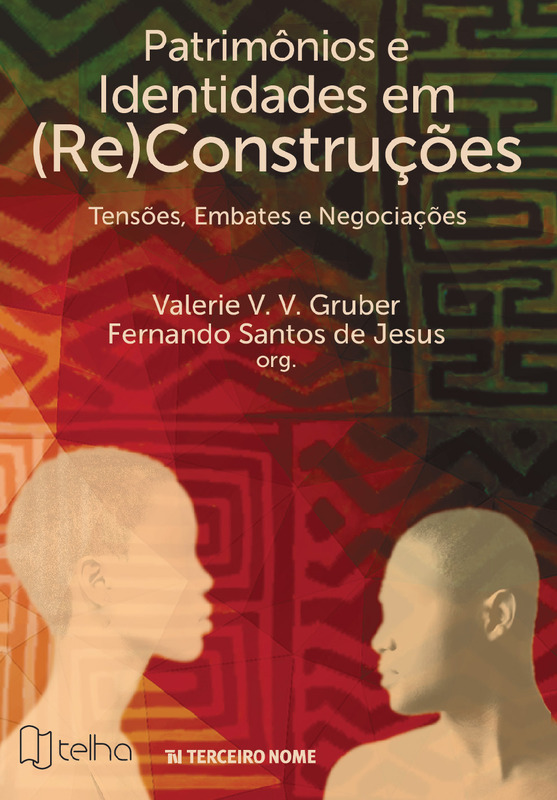
Patrimônios e Identidades em (Re)Construções : Tensões, Embates e Negociações
In Zeiten von Spannungen, Veränderungen und Umbrüchen verdeutlicht dieses Werk, wie wichtig eine eingehende Beschäftigung mit Fragen der Identität und des kulturellen Erbes in Lateinamerika und Afrika ist. Die innovativen theoretischen Überlegungen der insgesamt 16 Autor*innen werden durch empirische Erkenntnisse aus Brasilien, Kolumbien, Südafrika, Angola und Kap Verde fundiert. Im ersten Teil des interdisziplinären Sammelbands wird die Pluralität von Identitätsbildungsprozessen in verschiedenen Kontexten erörtert, die von Forschung und Bildung bis hin zu Musik und Religion reichen. Der zweite Abschnitt beleuchtet Narrative, Erinnerungen und soziale Praktiken von Individuen und Gruppen, die in ihren Gesellschaften unsichtbar gemacht werden. Hierzu zählen afrobrasilianische Intellektuelle ebenso wie Bewohner*innen benachteiligter Nachbarschaften. Im dritten Teil liegt der Fokus auf politisch-ökonomischen, sozialen und technologischen Initiativen, die einerseits auf Innovationen und andererseits auf die Bewahrung des Natur- und Kulturerbes auf beiden Seiten des Atlantiks abzielen. Diese Anthologie ist das Resultat von kritischen Diskussionen, Reflexionen und der Eigeninitiative von engagierten Nachwuchswissenschaftler*innen, die im März 2017 am XVIII. Internationalen Forschungsseminar “Fábrica de Ideias: Patrimônio, Desigualdade e Políticas Culturais” in São Luís do Maranhão (Brasilien) teilgenommen haben. Inmitten der UN-Dekade für Menschen afrikanischer Herkunft (2015-2024) decken sie Ungleichheiten in Zusammenhang mit Erinnerungskulturen, Identitätskonstruktionen und politischen Aushandlungsprozessen auf. Durch eine Balance aus kritischen Analysen und konstruktiven Denkanstößen liefern sie mit diesem Werk einen grundlegenden Beitrag zu zeitgenössischen Debatten in den Kultur- und Sozialwissenschaften.
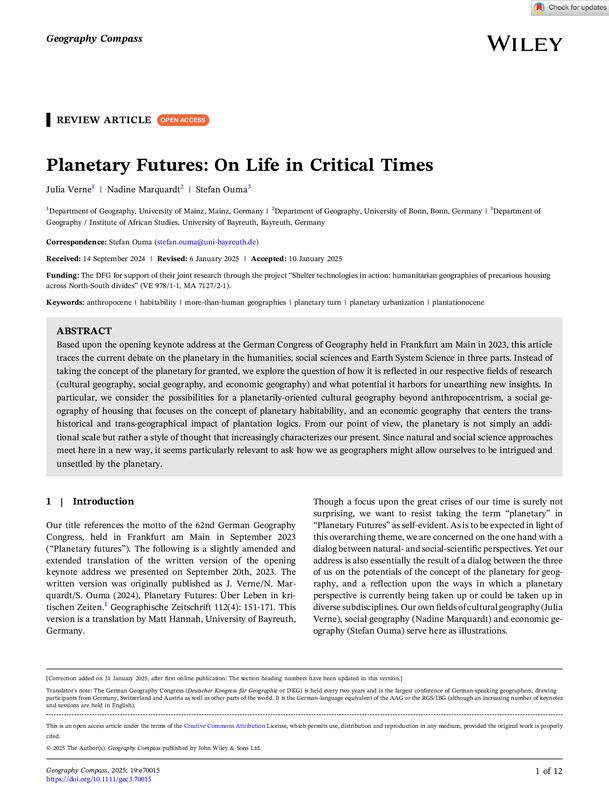
Planetary Futures : On Life in Critical Times
Based upon the opening keynote address at the German Congress of Geography held in Frankfurt am Main in 2023, this article traces the current debate on the planetary in the humanities, social sciences and Earth System Science in three parts. Instead of taking the concept of the planetary for granted, we explore the question of how it is reflected in our respective fields of research (cultural geography, social geography, and economic geography) and what potential it harbors for unearthing new insights. In particular, we consider the possibilities for a planetarily‐oriented cultural geography beyond anthropocentrism, a social geography of housing that focuses on the concept of planetary habitability, and an economic geography that centers the transhistorical and trans‐geographical impact of plantation logics. From our point of view, the planetary is not simply an additional scale but rather a style of thought that increasingly characterizes our present. Since natural and social science approaches meet here in a new way, it seems particularly relevant to ask how we as geographers might allow ourselves to be intrigued and unsettled by the planetary.
Pode o Subalterno Filmar? : Cinema Africano e Luta Anticolonial nos Anos 1960
Este libro es el resultado de mi investigación de maestría en Sociología que comenzó en 2012 y terminó en 2015 en la Universidad Federal de Pernambuco. Durante este período me interesó comprender las dinámicas sociales y culturales presentes en aquellos países llamados, muchas veces peyorativamente, el “tercer mundo”. En otras palabras, me propuse comprender lo que realmente se ha producido en términos políticos y poéticos en países que han vivido la experiencia del proceso colonial, desde una perspectiva decolonial y/o poscolonial. Inicialmente, mi enfoque estuvo en América Latina y la dinámica de la producción cinematográfica en el llamado Nuevo Cine Latinoamericano. Durante esta experiencia inicial me topé con algo hasta ahora insólito, pero aún poco cuestionado: la ausencia de estudios sociológicos sobre la producción cinematográfica africana. Recuerdo que la atención prestada a la producción literaria africana en ese momento gozaba de relativo prestigio dentro de la academia, con obras de autores angoleños y mozambiqueños traducidas y estudiadas en departamentos de sociología y literatura. Sin embargo, el cine africano, con raras excepciones, seguía siendo un tema marginado y poco discutido entre nosotros, sociólogos y académicos. La investigación buscaba, por tanto, abrir nuevas posibilidades de análisis dentro del campo de investigación sobre el arte y la cultura desde una perspectiva periférica y no hegemónica. Ahora con la publicación de este libro, existe la posibilidad de que un público no académico pueda leer y sumergirse en este mundo hoy un poco más debatido que en 2012, pero aún lejos de tener el merecido reconocimiento.